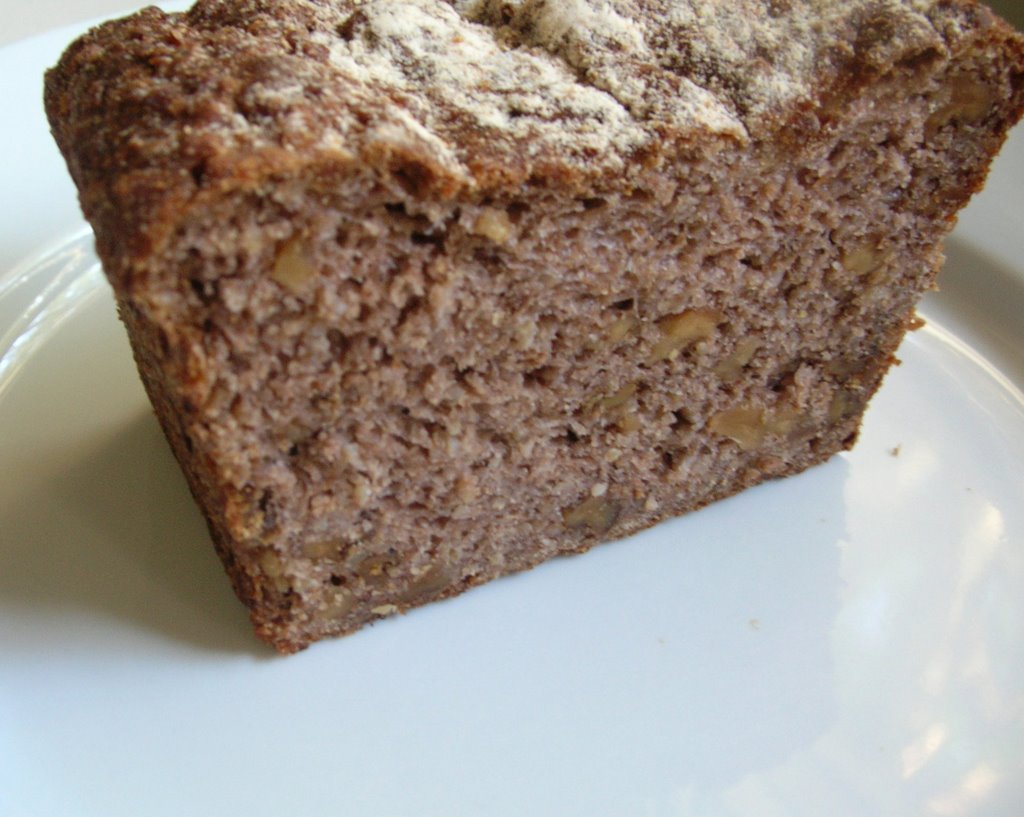
This loaf of bread had me worried. I paused my breadmaking session on Sunday while Dustin and I went for an impromptu two and a half hour walk, and stuck my bread in the fridge to tame those hungry little yeasts while we were gone, which I've heard is a legitimate thing to do, but when I returned from my walk, I opened the refrigerator door in anticipation, and my bread had risen so high that it was squished up against the top of the next shelf!
If I were a calm and patient baker, I would have punched down the loaf, rolled it up again into a little swaddle of bread dough, and let it rise while we had our Spaghetti and Meatballs for dinner (it was my turn to choose our Sunday supper), and then popped it in the oven and all would have been tall and rounded in the land of happy bread loaves. Instead, I chose to make due with the deformed loaf I had on my hands, and throw caution to the wind by sending it off to meet it's fate in a 385 degree oven.
The loaf came out flat and rather homely looking, but I wasn't about to give up on it just yet. I mean, if ever a bread and I were destined for true love, it had to be this Cracked Wheat Walnut Cider Loaf. Wholesome and rich with the taste of toasty walnuts, along with the substance and toothsome quality that bulgar would add, and the seductively unknown taste of cider in a loaf of bread? Wow, I'm still getting excited about it again, even after my botched first attempt.
The point is though, despite appearances, this is a bread to love. It might not seduce you with a tall and stately domed top, or a golden brown crust, but what it lacks in beauty, it makes up for in character. The bread turned out a fabulous purplish shade of brown, flecked with walnuts and bits of bulgar, and it is so wonderfully moist. I had a slice for breakfast with some pumpkin butter, and a slice for lunch with my broccoli soup. Plans for the rest of the loaf include a turkey and munster sandwich tomorrow, and then it's going to play host to some creamy goat cheese, served alongside a bowl of lentils for dinner tomorrow. This is one hardworking bread!
I have plans to make this bread again very soon, and I can't wait to see how it will turn out if I give it the proper space it needs to rise!
Cracked Wheat Walnut Cider Loaf
Adapted from Macrina Bakery, by Leslie Mackie
3/4 cup cracked wheat
1 cup boiling water
1 1/2 cups walnut halves
1 1/4 cups apple cider
1 1/2 teaspoons dried yeast
2 tablespoons honey
1 cup and 1 tablespoon coarse whole wheat flour
2 1/4 cups King Arthur's white wheat flour
2 teaspoons kosher salt
1/2 cup canola oil
Place the cracked wheat in a small bowl and cover with boiling water. Stir with a wooden spoon to make sure all wheat is moistened. Let sit, uncovered, for 10 minutes while liquid is being absorbed.
Preheat the oven to 325 degrees and spread the walnuts on a rimmed baking sheet to bake in the oven for about 10 minutes. Check the nuts after about 7 minutes though, to be sure they aren't browning too deeply. Remove the nuts form the oven and let cool. Coarsely chop and set aside.
Place apple cider in a medium saucepan and warm over low heat, until just warm to the touch. Pour the warm cider into the bowl of an electric mixer, fitted with the dough hook. Add the yeast and honey and whisk until the yeast is dissolved. Let mixture sit for 5 minutes. Add plumped cracked wheat, 1 cup whole wheat flour, the white wheat flour, kosher salt and canola oil. Mix on low speed for one minute, then increase the speed to medium and beat for 10 minutes. The dough will form a loose ball at the base of the hook. Add the walnuts and beat for an additional 2 minutes. Be sure to watch your mixture toward the end - they have a tendency to "hop" when they are working hard, and might hop right off your countertop!
Transfer the dough to an oiled, medium bowl and cover with plastic wrap. Let proof in a warm room, 70 - 75 degrees for 2 hours. Dough will almost double in size. The dough is done rising when you can poke your finger into it and the indentation stays. Punch down the dough and turn out onto a lightly floured work surface. The dough will be sticky, but don't add more flour. Gently shape the dough into a 12 by 6 inch log, with the long end facing you. Turn the egdes in to meet in the middle, then start rolling the dough away from you into a loaf, and place the loaf in a 9 x 5 x 4 inch oiled loaf pan. Cover with plastic wrap and let proof at room temperature about an hour, or until the loaf rises slightly above the pan.
While the loaf is proofing, preheat the oven to 385 degrees. Remove the plastic from the loaf and dust with the remaining tablespoon of whole wheat flour. Place the pan on the center rack of the oven and bake for approximately 50 minutes. The finished loaf will be medium brown on top. Let the loaf cool in the pan for 30 minutes on a wire rack, then run a sharp knife around the edges of the pan to invert the bread onto the rack to cool completely.
Makes One Loaf





 Posts
Posts


